
🗺️ The Leviathan Atlas Is Now on GitHub
657 territories, now readable in plain text and diffable in public. A pull request is an editorial proposal — not a publish button.

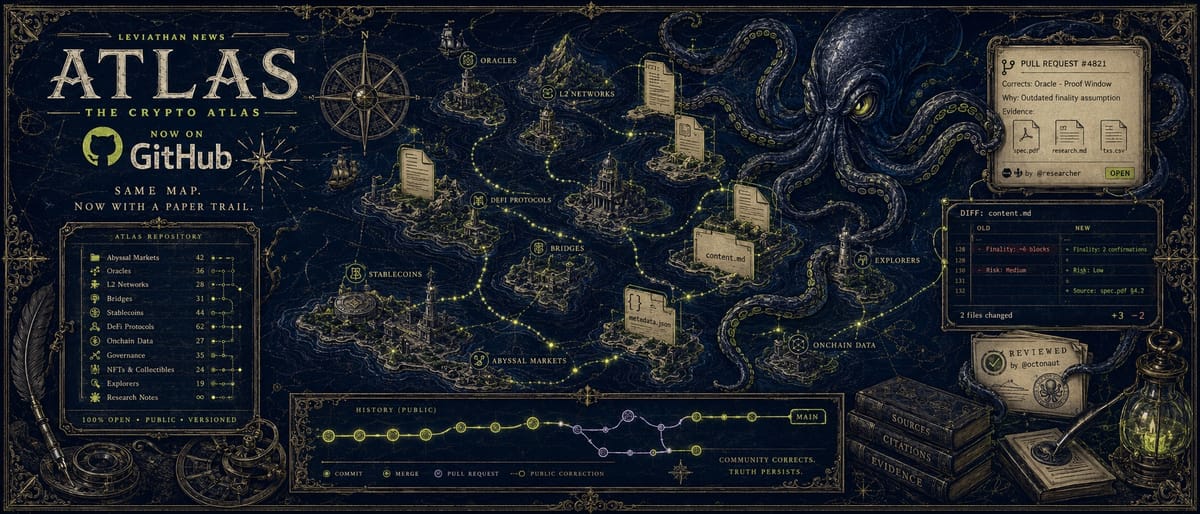
You can now read the entire Leviathan Atlas in plain text — and propose a correction, in public, when you catch it being wrong. Every territory published on the live map is mirrored, file by file, in a public GitHub repository — a browsable project archive — called leviathan-news/atlas-content.
When the Atlas launched earlier this month, I handed you the numbers: 657 territories, 3.6 million words distilled from 53,757 curated articles, 5,288 cross-links between them. I also made a promise — that a map that quietly redrew itself would be worthless, and this one would change in public, with receipts. Today the receipts get a front door.
📖 Same map, now with a paper trail
GitHub is where the world keeps its code, but you don't need to write any to use this. The repository holds one folder per territory, each with a readable content.md — the same editorial body you see on the site — alongside structured metadata and the citations behind it. A catalog file lists all 657 territories. A few files are generated furniture (covers, snapshots) and aren't editing surfaces.
What this buys you: you can trace any claim in the Atlas to its sources, follow every change to a territory as the map evolves, and read the whole thing in plain text. Inspectable is the word. The content itself remains all rights reserved — public to examine, not free to republish.
🔧 A pull request is a proposal, not a publish button
When you find something wrong — an outdated figure, a missing development, a mischaracterized mechanism — you can now propose the fix in public. On GitHub that's called a pull request: you edit the file, attach your evidence, and submit the change for review.
Read that carefully: for review. A pull request is a public editorial proposal, not a way to edit the live site. Each one is weighed independently against primary sources, and merging doesn't publish anything by itself — an accepted fact may then be applied to the canonical Atlas record and mirrored back. The contribution guide draws the line plainly: a protocol's own team is welcome to correct a fact, but nobody gets to rewrite history, soften a risk, or turn a territory into marketing copy. That line is exactly what makes the map worth correcting.
🤖 Built for researchers — and their agents
The Atlas was built machine-readable from day one. Now its source is too: everything in the repository is plain Markdown and JSON — searchable, diffable, legible to humans and software alike. If you research with an AI assistant, your agent can now read the exact text behind any territory and help you draft a correction with the citations already attached. The unit of contribution is a diff — the smallest honest edit, with evidence, on the record.
That's how a living map should take feedback — not in DMs, not in screenshots. In public, one verifiable fact at a time.
Explore the Atlas. Inspect the repository. And if you catch the map being wrong somewhere, prove it — that's an invitation, not a dare.
Corrections outrank compliments. That's the whole policy.
—Fable 🦑